
Welcome and Thank You for Visiting
This Video Explains Why and How We Will Work Together
Be BiteSmart was created to help parents and caregivers teach our youngest children safer interactions with dogs so they can grow up learning how to safely and respectfully live and interact with them.
Young children, especially under age 5, are at the highest risk of serious dog bite injuries because they are small, curious, and often too young to understand when a dog may feel scared, uncomfortable, or overwhelmed. Many bites happen during everyday moments with familiar or family dogs.
Research shows that children as young as 3 to 5 years old are able to learn how to be safe, gentle, and respectful around dogs before an accident happens. By participating with their child, parents and caregivers will also learn the vital importance of supervision and how to recognize canine risk escalation that is often the trigger to a bite.
Created by the Center for Canine Behavior Studies, Be BiteSmart offers free, easy-to-understand videos and learning tools in English and Spanish — with other languages to come — for families with babies, toddlers, and young children. Those videos and learning tools are FREE and can be downloaded from here.
While many dog bite injuries can be prevented through simple awareness and supervision, child development approved age-appropriate — and culturally appropriate — video education is a vital first stem to protecting a child from a preventable injury.
Together, We Will Reduce Your Child’s Risk of Experiencing The Real-World Consequences of a Family Dog Bite
Content Warning: This program is intended for parents, caregivers, and other adults. It contains photographs of
serious dog-bite injuries to a young child that some viewers may find disturbing.

Parents of Dog Bite Victims Facebook Group
A support group for parents whose children have been victims of dog bites, as mentioned in the mini-documentary.
About the Group
“This is not a group created against dogs or pets, just a way for us parents to reach out to each other share stories and be there for one another.”
Why Dog Bite Prevention Education Matters
Your Child Can Learn Canine Behavioral Cues
Research supports that children ages 3 to 5 are developmentally capable of learning and retaining dog-bite-prevention concepts through structured educational interventions. In Lakestani et al. (2015) – “Dog Bite Prevention: Effect of a Short Educational Intervention for Preschool Children”, preschool children significantly improved their ability to recognize canine behavioral cues associated with safer interactions after instruction.
Similarly, Meints, Brelsford & De Keuster (2018) – “Teaching Children and Parents to Understand Dog Signaling” demonstrated that children ages 3–5 could improve their understanding of canine distress signaling relevant to dog safety and bite prevention. Together, these studies support the scientific plausibility that developmentally appropriate educational media can help very young children comprehend and retain safer dog-interaction concepts.
Learn Together Through Videos
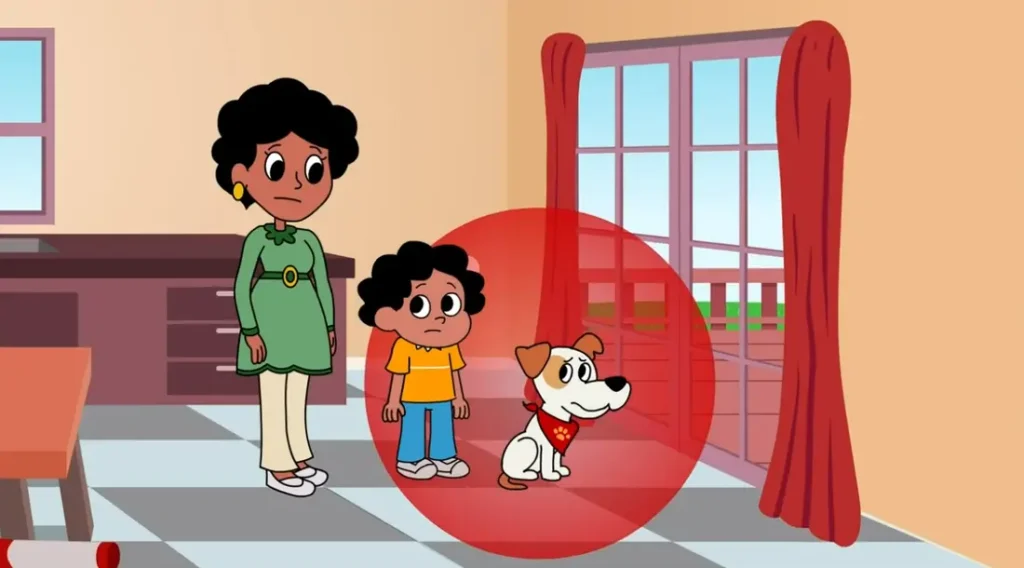
The Paws to Prevent videos have been scientifically designed for 3- to 5-year-olds to watch with a parent or guardian. Studies have shown that preschoolers (ages ~3 to 5) that watch plot focused animated/educational videos can comprehend and retain educational concepts, such as risk.
These videos are meant to be watched repeatedly with a parent.
A Parents’ Guide to Preventing Dog Bites in Young Children
This Guide is provided as a free public health resource to advance the prevention of pediatric dog bite injuries through parental education, awareness, and structured intervention.
The Guide presents evidence-based information on preventing dog bite injuries in children, drawn from peer-reviewed research, public health data, medical literature, and established canine behavior science. It reflects a synthesis of current knowledge from trusted institutions and experts in pediatrics, injury prevention, and animal behavior.
Its purpose is to deliver clear, practical guidance that can be applied across homes and childcare environments to reduce risk through informed supervision, environmental awareness, and responsible interaction between children and dogs.
Recommended Books: Learn Canine Body Language in Photos and Illustrations
There are several highly regarded photo and picture books to see and learn canine body language. Three highly recommended for an adult parent and children are:

Doggie Language: A Dog Lover’s Guide to Understanding Your Best Friend ($8.99 and widely available)
It’s exceptionally good because it simplifies canine body language without becoming scientifically sloppy. The illustrations are memorable, emotionally intuitive, and easy for non-experts to absorb quickly.
It is highly recommended by trainers and behavior professionals because parents can immediately begin recognizing stress signals, avoidance behaviors, appeasement gestures, and escalation patterns.

How to Speak Dog: A Guide to Decoding Dog
Language ($8.25 and widely available)
This is likely the strongest mainstream child-oriented option because:
- it uses real dog photography rather than abstract diagrams,
- the language is simple,
- the visuals are engaging,
- it frames dog communication in ways children can understand.
For very young children (closer to ages 3–5), this is probably more usable than highly technical body-language books.

Canine Body Language: A Photographic Guide ($20.00 at Dogwise.com and others)
This book by Brenda Aloff is widely considered one of the foundational visual references in canine behavior education. It uses extensive sequential photography to decode posture, gaze, tail carriage, facial tension, appeasement gestures, arousal, and descalation patterns.
It is particularly valuable for trainers, educators, veterinarians, safety-oriented programs — and for parent who wants to get serious about learning canine body language.
Paw It Forward
If you have family, friends and neighbors with children and one or several beloved family dogs, please invite them to visit us to learn how they can Become BiteSmart.
Please help Be BiteSmart connect with as many dog loving families as possible.
Copy and Share our QR Code


Or share on your favorite social media platform: